The Accelerator Ache
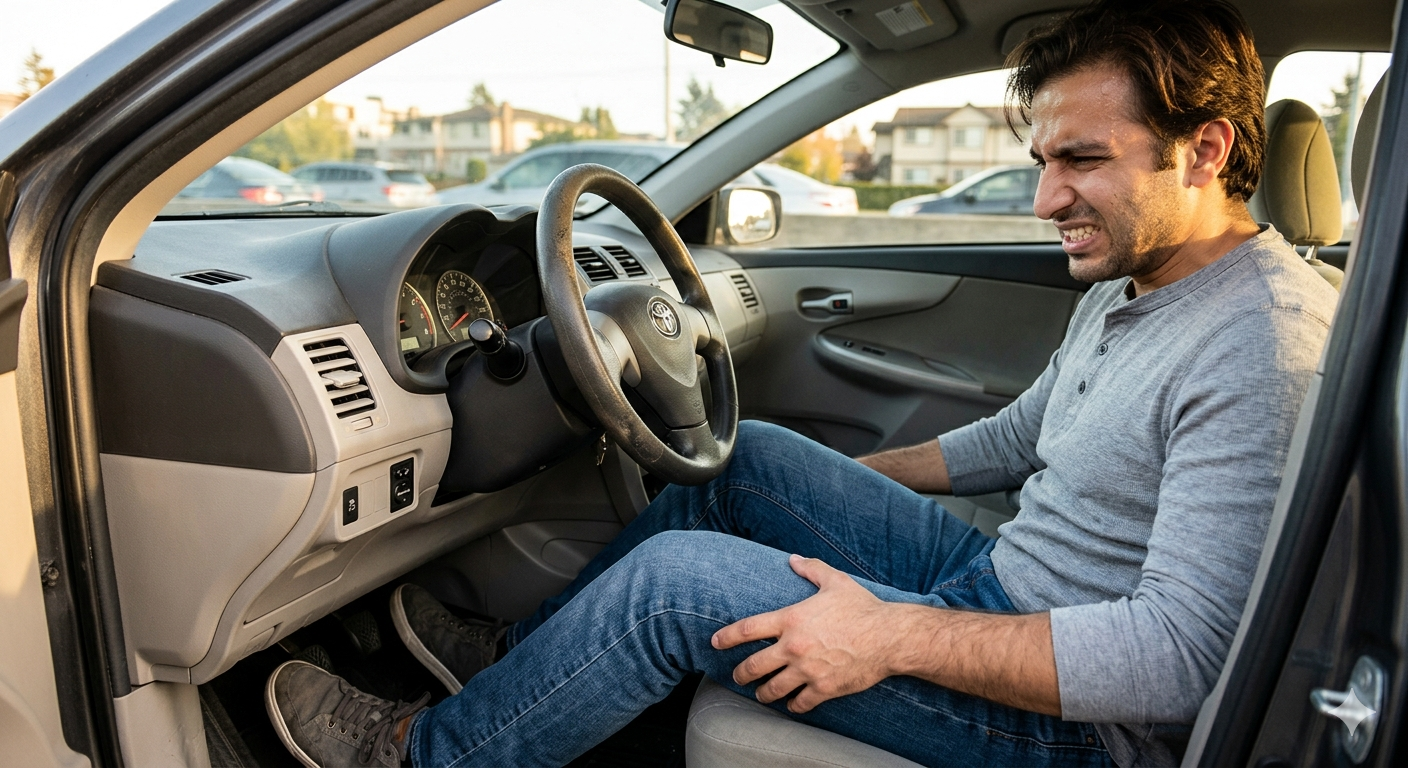
When we talk about driving fatigue in Indian cities, the conversation almost always points to the “clutch leg.” Pushing a heavy pedal thousands of times a week in bumper-to-bumper traffic is notoriously hard on the left side of the body. But what happens when the pain strikes the right side?
Many drivers operating in the chaotic traffic of cities like Delhi, Mumbai, or Bengaluru experience a persistent, burning ache in their right shin, a deep tightness in their right hip, or sharp pain shooting down their lower right back. Even drivers of automatic cars—who have completely eliminated the clutch—are falling victim to this right-sided syndrome.
While the left leg acts as the heavy lifter, the right leg is the micro-manager. And in Indian driving conditions, micro-management takes a severe physical toll.
The Biomechanics of the “Pivot and Hover”
To understand why your right leg and hip hurt, you have to look at the continuous, asymmetrical demands placed on your right foot. Unlike the left foot, which pushes linearly on a single pedal, the right foot is responsible for two pedals: the accelerator and the brake.
Ideally, proper driving technique dictates that you plant your right heel on the floorboard directly in front of the brake pedal. To accelerate, you pivot the top half of your foot to the right; to brake, you pivot it back to the center.
However, in unpredictable Indian traffic—where two-wheelers weave into your lane, pedestrians cross unexpectedly, and auto-rickshaws stop without warning—your right foot rarely gets to rest on the accelerator. Instead, it spends hours engaged in the “hover.” You hold your foot slightly lifted off the pedals, tensed and ready to slam the brakes at a millisecond’s notice.
This hovering requires your shin muscles, quadriceps, and hip flexors to fire constantly without any release. You are essentially performing a prolonged isometric hold, trapping tension entirely on the right side of your lower body.
The Right-Hand Drive Posture Trap
In India, we drive right-hand drive (RHD) vehicles. This design, combined with our driving habits, creates a unique postural trap that severely impacts the lower back.
Think about your posture when you are stuck at a long signal or crawling through traffic. Most drivers naturally lean to the right, resting their right elbow on the door armrest or the window sill.
When you continuously drop your right shoulder and lean your weight onto the driver’s side door, your spine loses its neutral alignment. You create a lateral (sideways) curve in your lower back. Your body weight shifts unevenly, compressing the intervertebral discs on the right side of your lumbar spine and putting immense pressure on your right Sacroiliac (SI) joint. Over months and years, this simple habit of leaning to the right manifests as chronic lower right back pain.
The Anatomy of the Pain: What’s Actually Hurting?
When the right side of your lower body begins to break down from driving, the pain usually falls into one of three distinct categories.
1. The Shin Burn (Tibialis Anterior Fatigue)
If you feel a burning ache down the front of your right lower leg, you are overworking your tibialis anterior—the muscle responsible for flexing your foot upward. This happens when you sit too close to the steering wheel. Because your leg is cramped, you have to acutely flex your ankle upward to clear the pedals when switching from the accelerator to the brake. Doing this thousands of times a week causes severe muscle fatigue.
2. Hip Flexor Tension
Your psoas and iliacus muscles connect your lower spine to your upper thigh. When you hover your right foot over the brake in anticipation of traffic, these muscles contract to hold your leg up. Because they never get a break to fully lengthen, they shorten and tighten. A tight right psoas pulls directly on the right side of your lower spine, creating a dull, persistent ache deep in your hip and lower back.
3. Piriformis Syndrome and “Sciatica”
Your right leg is often extended further than your left to reach the accelerator. This continuous extension keeps the deep gluteal muscles—specifically the piriformis—under constant tension. When the piriformis muscle on your right side becomes inflamed and tight, it can compress the sciatic nerve running directly beneath it.
This compression results in a sharp, shooting pain, tingling, or numbness that radiates from your right buttock all the way down the back of your right thigh. Drivers often mistake this for a slipped disc, but it is frequently a muscular issue caused by driving ergonomics.
Bad Habits That Make It Worse
1. The “Wallet Sciatica”:
Keeping a thick wallet in your right back pocket is one of the worst things you can do for your spine. It acts as a wedge, artificially elevating the right side of your pelvis. This forces your lumbar spine to bend sideways to keep your head level, accelerating right-sided disc compression.
2. Driving Barefoot or in Flip-Flops:
Without the structural support of a solid shoe sole, your foot has to work much harder to depress the pedals. Barefoot drivers often grip the pedals with their toes, leading to plantar fasciitis and radiating tension up the right leg.
3. Sitting Too Close:
In an effort to see the bumper of the car ahead in tight traffic, many drivers pull their seats aggressively forward. This jams the right leg into an unnatural, compressed angle, eliminating the ability to pivot from the heel.
See How the Pain Develops
Understanding exactly how that deep glute pain triggers nerve issues can help you visualize the problem. This brief breakdown explains the mechanics of Piriformis Syndrome and how it mimics spinal issues:
Key insight: If the shooting pain in your right leg worsens after a long commute but improves when you walk around, the culprit is highly likely to be a tight piriformis muscle compressing the nerve, not a structural spinal injury.
How to Fix the Right-Sided Ache
You cannot change the grueling nature of Indian traffic, but you can alter your environment to protect your body.
1. Master the Heel Pivot
Adjust your seat distance so that you can plant your right heel firmly on the floor in front of the brake pedal. You should be able to reach the accelerator by simply pivoting your toes to the right without lifting your heel off the floor. This completely eliminates the need to use your entire leg to switch pedals, saving your hip flexors and shins.
2. Level Your Spine (Stop Leaning)
Consciously break the habit of resting your right elbow on the door. Keep both hands lightly on the steering wheel (in the 9 and 3 o’clock positions) and ensure your weight is distributed equally across both sit bones. If your car has a center armrest, use it sparingly, or ensure you aren’t dropping your left shoulder to compensate.
3. Empty Your Pockets
Before you sit down, remove your wallet, phone, and keys from your back pockets. You need a completely flat surface to maintain a neutral pelvis.
4. Optimize Your Seat Angle
-Recline your seat slightly to about 100 to 110 degrees. Sitting at a rigid 90-degree angle maximizes vertical compression on your lower spine. A slight recline transfers some of your upper body weight into the backrest, giving your lumbar discs a break. If your car lacks built-in lumbar support, use a small cushion behind the natural curve of your lower back.
-Driving in heavily congested cities is stressful enough without the added burden of chronic physical pain. By correcting your right-foot pivot mechanics and forcing yourself out of the “RHD slump,” you can protect your spine and hips, making your daily commute significantly more bearable.
What are the best stretches to relieve right-sided driving pain, specifically for a tight psoas and piriformis muscle?
It is great that you are zeroing in on the psoas and piriformis muscles. These two muscles are the undisputed culprits behind right-sided driving pain.
When you spend hours hovering your foot over the pedals, your psoas shortens and pulls on your lower back, while your piriformis tightens and clamps down on the sciatic nerve. You need to pull them in the opposite direction to undo the damage.
Here are the most effective, biomechanically sound stretches to release that built-up tension, structured for easy integration into your day.
Releasing the Right Psoas (Hip Flexor)
The goal here is to open up the front of your right hip, reversing the “seated” position it gets stuck in behind the wheel.
1. The Kneeling Hip Flexor Stretch
This is the gold standard for directly targeting a tight right psoas.
-Kneel on your right knee, placing a towel or cushion underneath it for comfort.
-Plant your left foot flat on the floor in front of you, creating a 90-degree angle with your left leg.
-Keep your torso perfectly upright. A common misconception is that you need to lean heavily forward—this actually shifts the stretch away from the psoas.
-Tuck your pelvis slightly under (imagine trying to point your tailbone at the floor) and gently squeeze your right glute.
-Shift your weight forward just an inch or two until you feel a deep stretch in the front of your right hip.
-Hold for 30 to 45 seconds, breathing deeply.
2. The Glute Bridge
While technically an activation exercise rather than a passive stretch, strengthening the glutes forces the opposing muscle group (the psoas) to relax through a process called reciprocal inhibition.
-Lie flat on your back with your knees bent and feet flat on the floor, hip-width apart.
-Push through your heels and squeeze your glutes to lift your hips toward the ceiling.
– Create a straight line from your knees down to your shoulders.
-Hold the top position for 3 seconds, focusing on the glute contraction, then lower slowly.
-Repeat for 10 to 15 repetitions.
Releasing the Right Piriformis (Deep Glute)
The piriformis muscle lies deep beneath your main glute muscles. Releasing it requires external rotation of the hip to relieve pressure on the sciatic nerve.
1. The Supine Figure-Four Stretch
This stretch allows you to use your upper body and gravity to safely open the right hip without straining your lower back.
-Lie flat on your back with your knees bent and feet on the floor.
-Cross your right ankle over your left knee, creating a “figure-four” shape.
-Reach your hands around your left thigh (or shin, for a deeper stretch) and gently pull your left leg toward your chest.
-Keep your right foot slightly flexed to protect your right knee joint.
-You should feel a deep, relieving pull in your right buttock.
-Hold for 30 to 60 seconds.
2. The Seated Chair Stretch
This is the perfect stretch to do at your desk immediately after a stressful commute.
-Sit upright in a sturdy chair with both feet flat on the floor.
-Cross your right ankle over your left knee.
-Place your right hand gently on your right knee, applying a very light downward pressure.
-Keeping your spine completely straight, hinge forward at the hips. Do not round your lower back.
-Stop when you feel a strong stretch deep in your right glute.
-Hold for 30 to 45 seconds.
A Note on “Pushing Through the Pain”
It is a common misconception that stretching must be intensely painful to be effective. If you feel a sharp, pinching sensation—especially in the front of your hip joint or shooting down your leg—stop immediately. You should feel a dull, manageable tension (a “pull”), not sharp nerve pain. Over-stretching an inflamed piriformis can actually aggravate the sciatic nerve further.