
Why there’s sudden Sharp pain in shoulder during dips in gym?
Let’s Discuss it’s Causes, Immediate Steps, and Recovery
You are midway through your upper-body routine, feeling strong. You mount the parallel bars for a set of dips, lower your body, and right at the bottom of the movement—’bang’. A sudden, sharp, and highly localized pain spikes through the front or side of your shoulder. It is a jarring sensation that instantly kills your set and leaves your arm feeling weak, achy, or completely frozen.
If you have experienced this, you are far from alone.
The dip is an incredible builder of chest and triceps mass, but it is also one of the most notoriously dangerous exercises for the shoulder joint.
A sudden, sharp pain is your body’s emergency brake, signaling that a structural limit has been breached.Understanding why this happens, identifying the likely culprit, and taking the right immediate steps can mean the difference between a minor tweak and a season-ending injury.
The Biomechanics: Why Dips Put Shoulders at Risk
To understand why your shoulder just yelled at you, you have to look at the mechanics of the dip.
The shoulder (glenohumeral joint) is a ball-and-socket joint designed for maximum mobility, which inherently compromises its stability. It relies heavily on a delicate network of muscles, tendons, and ligaments primarily the rotator cuff to keep the ball centered in the socket.
During a dip, your shoulder is forced into extreme extension (your arms moving backward behind your torso) while simultaneously bearing your entire body weight. As you lower yourself, the head of your humerus (upper arm bone) is pushed forward and upward.This movement forcefully shrinks the subacromial space (the narrow gap beneath the tip of your shoulder blade where your rotator cuff tendons and bursa sac sit).
If your form shifts, if you drop too low, or if your shoulder stabilizers are fatigued, the structures in that tiny space get violently pinched or stretched.
What Just Happened? The 4 Common Culprits
A sudden, sharp pain usually points to an acute injury or the abrupt aggravation of a hidden, chronic issue. Here are the most likely anatomical culprits when a dip goes wrong:
1. Acute Shoulder Impingement
This is the most common cause of sudden dip pain. As you descend into the bottom of the dip, the humerus drives up into the acromion (the roof of the shoulder). If the rotator cuff tendons or the bursa (a fluid-filled sac that reduces friction) get trapped between these bones, it causes a sharp, pinching sensation, usually at the front or top of the shoulder.
The feeling: A sharp pinch at the deepest part of the dip, often followed by a lingering, dull ache when you lift your arm overhead afterward.
2. Rotator Cuff Strain or Tear
Your rotator cuff is a group of four small muscles responsible for stabilizing the shoulder. During a heavy dip, these small muscles are working overtime to keep your shoulder joint from popping out of place. If the load exceeds their capacity, or if a sudden loss of tension occurs, one of these tendons (frequently the supraspinatus) can tear or severely strain.
The feeling: A sudden tearing or snapping sensation, followed by immediate weakness. You may struggle to lift your arm out to the side against any resistance.
3. Labral Tear (SLAP Tear)
The labrum is a thick ring of cartilage that deepens the shoulder socket, acting like a bumper to keep the humerus securely in place. The extreme mechanical stress at the bottom of a dip can peel or tear this cartilage, especially where the biceps tendon attaches (a SLAP tear).
The feeling: A deep, internal shoulder pain accompanied by a distinct “catching,” “clicking,” or “popping” sensation within the joint. It often feels like the shoulder is momentarily slipping out of place.
4. AC Joint Sprain
The acromioclavicular (AC) joint is where your collarbone meets your shoulder blade. Dips place an immense amount of upward shear force on this joint. If your shoulders shrug upward toward your ears during the movement, the ligaments holding the AC joint together can stretch or tear.
The feeling: Sharp pain localized specifically at the very top of the shoulder, exactly where the collarbone ends. It may hurt to press on the top of the shoulder or to reach across your body.
Immediate Action: What to Do Right Now
If you have just experienced this sharp pain, your workout is over for the day or at least for any pushing movements. Pushing through joint pain is a guaranteed way to turn a minor strain into a surgical tear.
1. Stop Immediately:
Step off the dip station. Do not try to “test” it with a lighter set or pushups.
2. Assess Mobility:
Gently move your arm through a basic range of motion without weights. Can you lift it to the front? To the side? Does it click or catch? Mental notes here will help a physiotherapist diagnose you later.
3. Apply Ice:
In the first 24 to 48 hours, apply ice for 15-20 minutes every few hours to blunt the acute inflammatory response and manage pain.
4. Rest and Protect:
Avoid movements that recreate the pain. This usually means no overhead pressing, no bench pressing, and absolutely no dips.
When to See a Doctor?
You should consult a sports physician or physical therapist if you experience any of the following “red flag” symptoms:
-Visible deformity or a massive bruise forming around the shoulder/bicep.
-Total inability to lift your arm straight out in front of you or to the side.
-A feeling of dead weight or severe weakness in the arm.
-Pain that wakes you up at night or refuses to subside after a week of rest.
Rehabilitation and Prevention: Fixing the Root Cause
Once you have rested and the acute pain has subsided, you cannot simply jump back onto the dip bars. You need to address why it happened.
Most dip injuries are the result of poor form, insufficient mobility, or weak stabilizers.
1. Correct Your Dip Form
When you eventually return to dips, your mechanics must be flawless:
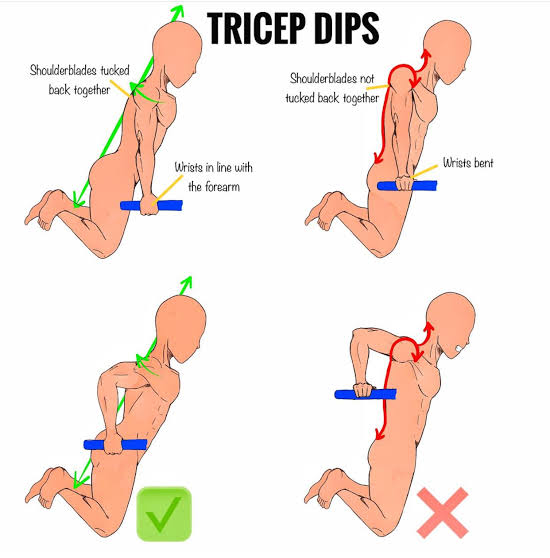
–Retract and Depress: Before you descend, pull your shoulder blades back and down (away from your ears). Keep them locked there. If your shoulders shrug up during the movement, you are impinging the joint.
-Limit Depth: Do not break 90 degrees. Your elbows should not go higher than your shoulders. Sinking incredibly deep into a dip provides marginal chest gains but exponentially increases shoulder risk.
–Lean Forward Slightly: A perfectly upright torso forces maximum shoulder extension. Leaning slightly forward recruits more of the massive pectoralis muscles and takes some sheer force off the front of the shoulder.
2. Strengthen the Stabilizers
Your rotator cuff and upper back need to be strong enough to handle your body weight. Incorporate the following into your warm-ups and pulling days:
–Face Pulls: Excellent for strengthening the rear delts and external rotators.
–Scapular Pushups: Great for strengthening the serratus anterior, a muscle crucial for keeping your shoulder blades pinned to your ribcage.
–External Rotations: Use a light cable or resistance band to keep the rotator cuff resilient.
3. Improve Thoracic Mobility
If your upper back (thoracic spine) is stiff and rounded, your shoulder blades cannot move properly. This forces the glenohumeral joint to compensate, leading directly to impingement. Regular use of a foam roller on your mid-back can drastically improve your overhead and dipping mechanics.
Safe Alternatives to Dips
If your shoulder is prone to impingement, or if you simply decide the risk-to-reward ratio of dips isn’t worth it, you can still build a massive chest and triceps. Dips are not mandatory.
For Triceps:
Close-grip bench presses, cable tricep push downs, and skull crushers provide excellent mechanical tension without the extreme shoulder extension.
For Lower Chest:
Decline dumbbell presses or high-to-low cable crossovers target the lower pectoral fibers safely and effectively.
Final Thoughts-
A sudden sharp pain during a dip is a harsh wake-up call, but it is also an opportunity to re-evaluate your shoulder health. Respect the complexity of your anatomy. By taking the injury seriously, resting adequately, and returning with better form and stronger stabilizers, you can ensure that this setback is just a temporary pause in your training journey, rather than a permanent roadblock.