
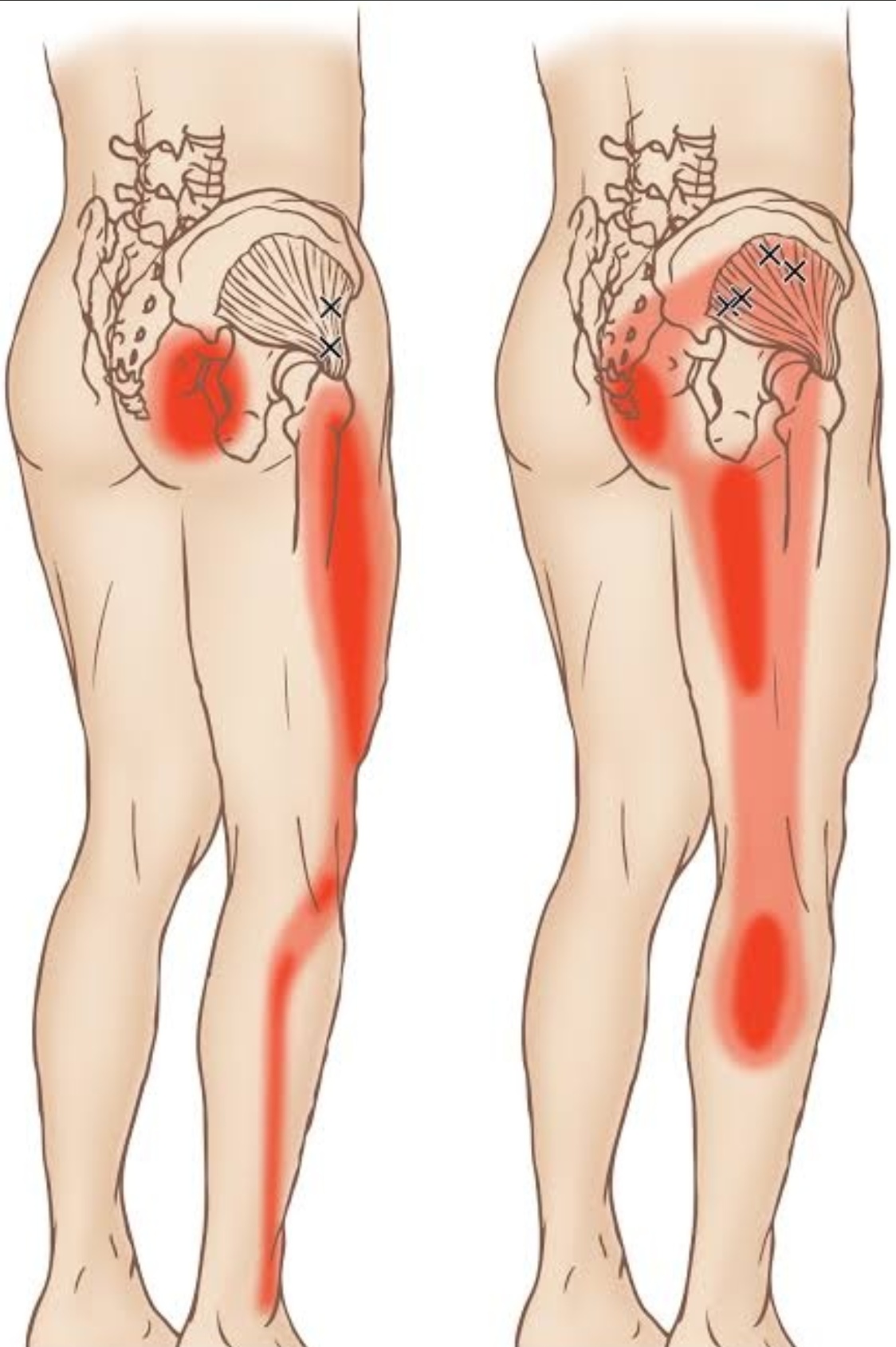
Why is there a deep pain referring down the back of the leg if it’s not coming from the spine?
Deep Ache in the Leg: Unraveling Piriformis Syndrome and Myofascial Trigger Points
When you experience a deep, burning, or throbbing ache radiating down the back of your leg, the immediate assumption is often “sciatica.” You picture a slipped or herniated disc in your lumbar spine pressing harshly against a nerve root. However, as many frustrated patients discover, an MRI of the lower back can come back completely normal, yet the agonizing pain persists.When the spine is ruled out, medical detectives must look elsewhere along the nerve’s pathway.
Two of the most common, yet frequently misunderstood, culprits for this referred leg pain are Piriformis Syndrome and Myofascial Trigger Points. Often existing simultaneously and feeding into one another, these soft-tissue disorders can perfectly mimic a spinal injury.
This comprehensive guide delves into the anatomy, mechanics, symptoms, and solutions for the deep ache caused by piriformis syndrome and trigger points, empowering you to understand and treat the true source of your pain.
Part 1: The Anatomy of the Ache
To understand why your leg hurts when your spine is healthy, you have to trace the neurological and muscular map of the pelvis and lower extremities.
–The Sciatic Nerve
The sciatic nerve is the longest and thickest nerve in the human body. It is formed by the union of several nerve roots exiting the lower spine (L4, L5, S1, S2, and S3). These roots bundle together deep in the pelvis to form a cable-like nerve that is nearly as thick as your thumb. From the pelvis, the sciatic nerve travels through the buttocks, down the back of the thigh, and branches out at the knee to serve the lower leg and foot.
–The Piriformis Muscle
The piriformis is a small, pear-shaped muscle located deep within the buttocks, lying underneath the much larger gluteus maximus. It originates on the front surface of the sacrum (the triangular bone at the base of your spine) and attaches to the greater trochanter, the bony prominence on the outside of your hip (femur).The primary job of the piriformis is external rotation of the hip—it helps turn your leg and foot outward. It also plays a vital role in stabilizing the hip joint and maintaining balance when you are walking or shifting weight from one foot to the other.
–The Anatomical Intersection
The relationship between the piriformis muscle and the sciatic nerve is the crux of the problem. In most people (about 80%), the sciatic nerve exits the pelvis by passing directly underneath the piriformis muscle. However, in up to 20% of the population, the nerve (or a branch of it) pierces directly *through* the belly of the piriformis muscle. Regardless of your specific anatomy, the nerve and muscle are intimate neighbors. If the muscle undergoes changes, the nerve is highly vulnerable.
Part 2: Understanding Piriformis Syndrome
Piriformis syndrome occurs when the piriformis muscle spasms, hypertrophies (enlarges), or becomes tight and inflamed, thereby compressing or irritating the adjacent sciatic nerve.
Mechanisms of Injury: Why Does it Spasm?The piriformis rarely tightens up for no reason. It is usually a victim of biomechanical overload or direct trauma:
1. Overuse and Repetitive Strain:
Runners, cyclists, and rowers are highly susceptible. The repetitive motion of moving the leg forward while stabilizing the pelvis forces the piriformis to work continuously.
2. Prolonged Sitting (“Wallet Sciatica”):
Sitting for long periods, especially on a hard surface or with a thick wallet in your back pocket, applies direct physical compression to the piriformis muscle and the sciatic nerve beneath it. Over time, this decreases blood flow (ischemia) to the muscle, causing it to tighten.
3. Biomechanical Compensation:
If your primary hip muscles (like the gluteus medius and maximus) are weak—a common side effect of modern, sedentary lifestyles—the tiny piriformis has to work overtime to stabilize your pelvis. It is a small muscle trying to do the job of a large muscle, leading to exhaustion, spasm, and hypertrophy.
4. Trauma:
A direct fall onto the buttocks, a sudden twist of the hip, or a car accident can cause the piriformis to tear or bleed internally, leading to scar tissue and chronic tightness.
The Symptoms of Piriformis Syndrome
Because the sciatic nerve is being pinched, the symptoms strongly resemble spinal sciatica, but with key differences:
–Deep Buttock Ache:
A profound, aching pain deep in the center of the buttock is the hallmark symptom.
-Referred Leg Pain:
Pain, tingling, or numbness radiating down the back of the thigh and into the calf.
-Aggravating Factors:
The pain is drastically worsened by prolonged sitting, climbing stairs, walking up inclines, or squatting.
-Relieving Factors:
Lying down flat on the back often provides immediate but temporary relief by removing pressure from the area.
Part 3: Myofascial Trigger Points (The Hidden Culprits)
While Piriformis Syndrome involves a muscle compressing a nerve, Myofascial Trigger Points can cause identical radiating leg pain without any nerve compression at all. This phenomenon is known as “referred pain.”
What is a Trigger Point?
A trigger point is a hyperirritable spot located within a taut band of skeletal muscle or its surrounding fascia (connective tissue). Colloquially known as “muscle knots,” these points are microscopic areas where the muscle fibers are locked in a state of continuous contraction. According to the widely accepted “Energy Crisis Theory,” this sustained contraction severely restricts local blood flow, creating a pocket of oxygen deprivation (ischemia). The lack of oxygen prevents the muscle fibers from relaxing, while the buildup of metabolic waste products (like lactic acid) sensitizes the local pain nerves. It becomes a vicious, self-sustaining loop of spasm and pain.
The Magic of Referred Pain
The most baffling aspect of trigger points is their ability to project pain to distant areas of the body. You might have a knot in your hip, but you feel the pain in your calf. This happens due to a neurological phenomenon called *convergence-projection*. The nerves from the trigger point and the nerves from the leg both converge on the same pathway in the spinal cord before traveling to the brain. The brain, accustomed to receiving signals from the leg (which is injured more often), misinterprets the origin of the signal and “feels” the pain in the leg.
The “Pseudo-Sciatica” Muscles
Several muscles in the pelvic region can develop trigger points that refer pain down the back of the leg:
1. Gluteus Minimus:
This small muscle is the undisputed king of fake sciatica. Trigger points in the anterior (front) part of the muscle refer pain down the side of the thigh and calf. Trigger points in the posterior (back) part refer a deep, excruciating ache directly down the back of the thigh, calf, and into the ankle, perfectly mimicking a herniated L5/S1 disc.
2. Piriformis Trigger Points:
Aside from compressing the sciatic nerve, the piriformis can develop its own internal trigger points. These refer pain into the sacroiliac joint, across the entire buttock, and down the upper two-thirds of the back of the thigh.
3. Gluteus Medius:
Trigger points here refer pain deeply into the lower back, the crest of the pelvis, and the back of the upper thigh.
4. Hamstrings:
Knots in the upper hamstrings (right where they attach to the sit bones) can cause a deep ache that travels down the back of the knee and into the upper calf.
Note: It is highly common for Piriformis Syndrome and Trigger Points to co-exist. The spasm of the piriformis creates trigger points within itself, and the altered walking mechanics caused by the pain cause trigger points to form in the gluteus minimus and hamstrings.
Part 4: Diagnosis: Differentiating from the Spine
If an MRI is useless for diagnosing soft-tissue problems, how do doctors figure out if you have piriformis syndrome or trigger points? The answer lies in a thorough, hands-on clinical examination.
1. Palpation:
A skilled practitioner (such as a physical therapist, physiatrist, or chiropractor) will physically press into the muscles of the buttock. Trigger points will feel like hard nodules or taut bands. Pressing on them will typically elicit a “jump sign” (the patient flinches) and will reproduce the patient’s exact radiating leg pain.
2. The FAIR Test (Flexion, Adduction, Internal Rotation):
The patient lies on their unaffected side. The examiner bends the painful leg, brings it across the body, and rotates it inward. This forcibly stretches the piriformis muscle. If this reproduces the sciatic pain, it strongly indicates piriformis syndrome.
3. The Pace Sign:
The patient sits on the edge of a table and attempts to push their knees apart outward against the examiner’s resistance. Pain and weakness during this resisted external rotation suggest piriformis involvement.
4. Diagnostic Injections:
In stubborn cases, a doctor may use ultrasound or fluoroscopy guidance to inject a local anesthetic directly into the piriformis muscle. If the leg pain vanishes immediately, the diagnosis of piriformis syndrome is confirmed.
Part 5: Comprehensive Solutions and Management
Curing this type of leg pain requires a multi-pronged approach that calms the nervous system, releases the physical muscle knots, and corrects the underlying biomechanics that caused the issue in the first place.
Phase 1: Acute Pain Relief and Deactivation
The first goal is to break the pain-spasm cycle.
–Ischemic Compression:
Using a lacrosse ball, tennis ball, or foam roller, apply sustained, direct pressure to the tender spots in the buttocks. Do not just roll back and forth quickly; find the knot, sink into it, and hold the pressure for 30 to 90 seconds until the referred pain begins to fade. This temporarily cuts off blood flow, forcing a flush of fresh, oxygenated blood into the tissue when the pressure is released.
-Heat and Ice:
Ice can reduce acute inflammation if the sciatic nerve is highly irritated. Heat, on the other hand, is generally better for trigger points, as it draws blood flow to the ischemic muscle tissue and encourages relaxation.
-Dry Needling:
This is one of the most effective treatments for stubborn trigger points. A trained therapist inserts a thin monofilament needle directly into the trigger point. This elicits a “local twitch response”—an involuntary spinal cord reflex that forces the muscle fiber to instantly contract and then fully release, resetting the muscle’s neurological tone and instantly dissolving the knot.
-Medical Interventions:
NSAIDs (ibuprofen, naproxen) or muscle relaxants can provide temporary relief. In severe cases, corticosteroid injections to reduce nerve inflammation, or even Botox injections to temporarily paralyze a stubbornly spasming piriformis, can be utilized.
Phase 2: Restoring Length and Mobilit
Once the acute trigger points are deactivated, the shortened, tight muscles must be lengthened.
–The Figure-4 Stretch:
Lying on your back, bend both knees. Cross the ankle of the painful leg over the knee of the good leg. Grab behind the thigh of the good leg and gently pull it toward your chest. You should feel a deep stretch in the buttocks of the painful side.
–Pigeon Pose:
A popular yoga pose that intensely stretches the external rotators, including the piriformis.
–Nerve Gliding (Flossing):
If the piriformis has been tight for a long time, the sciatic nerve may have developed adhesions (scar tissue) that stick it to the surrounding muscle, preventing it from sliding naturally when you move your leg. Nerve flossing exercises gently mobilize the nerve, pulling it back and forth through its channel to break up these micro-adhesions without aggressively stretching the nerve itself (which can irritate it).
Phase 3: Corrective Strengthening
If you only massage and stretch, the pain will inevitably return. You must fix the underlying weakness that forced the piriformis or gluteus minimus into overload.
–Gluteus Medius Activation:
The gluteus medius is the primary stabilizer of the pelvis. Exercises like side-lying clamshells, lateral band walks, and single-leg glute bridges are essential for waking this muscle up.
-Core Stability:
A weak abdominal and lumbar core forces the pelvic muscles to compensate. Planks, bird-dogs, and dead-bugs teach the core to stabilize the spine, taking the structural burden off the hip rotators.
-Gait Analysis:
If you overpronate (your feet collapse inward when you walk), it forces your thigh to rotate internally, putting a constant, agonizing stretch on the external rotators like the piriformis. Custom orthotics or proper footwear may be the final key to permanent relief.
Conclusion:-
A deep ache referring down the back of the leg can strip away your mobility, ruin your sleep, and take a massive toll on your mental health. When an MRI fails to provide an answer, it is easy to feel hopeless. However, realizing that your pain likely stems from Piriformis Syndrome or Myofascial Trigger Points is actually a deeply empowering diagnosis.Unlike degenerative disc disease or spinal stenosis, which involve permanent structural changes to bone and cartilage, muscular and fascial dysfunctions are highly reversible. Muscles can be retrained. Fascia can be released. Trigger points can be deactivated. By understanding the intricate anatomy of your pelvis, seeking out manual therapy from skilled practitioners, and committing to targeted strengthening and stretching, you can untangle the knots, free the sciatic nerve, and finally step out of the shadow of chronic leg pain.